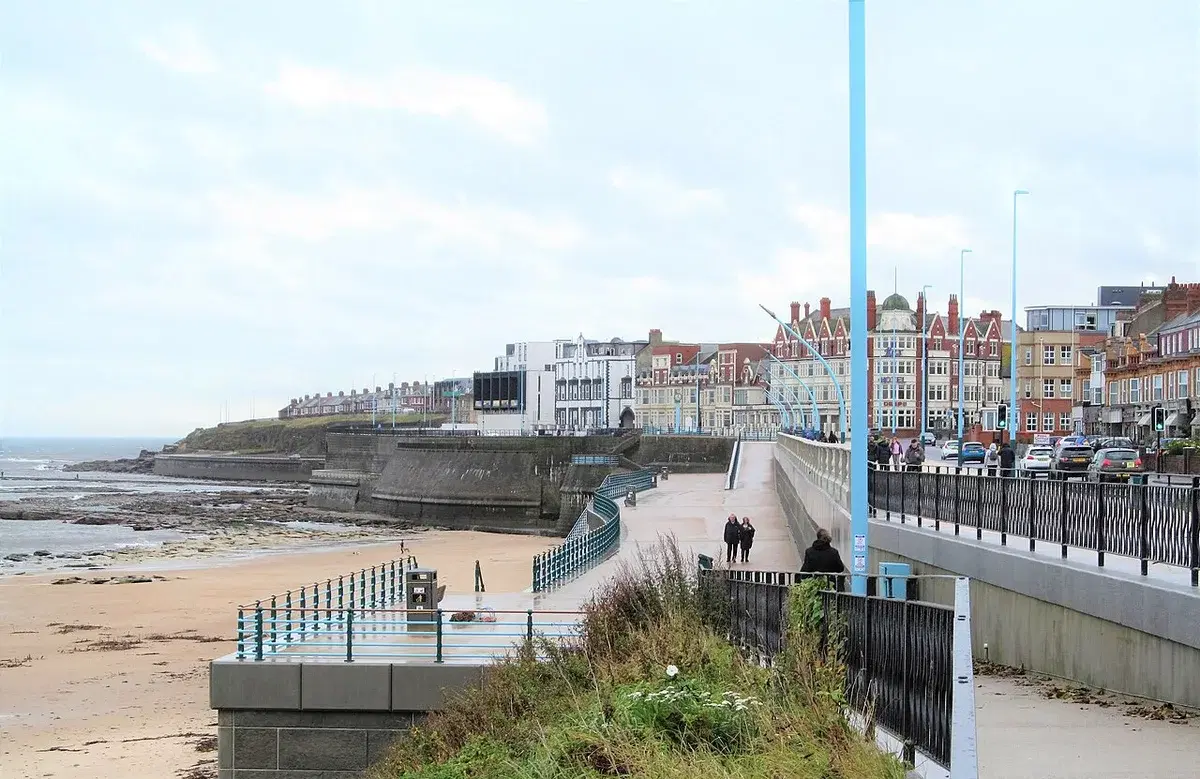
Whitley Bay: The Rise and Fall of the Seaside Resort
From a fishing village of 300 people to Tyneside's playground, through golden-age ballrooms and revolving beach chalets to boarded-up hotels -- and back again. The story of Whitley Bay.
Every British seaside town has a story of boom and bust. But few tell it as dramatically as Whitley Bay -- a town that barely existed in 1860, became one of the busiest resorts on the North East coast by 1910, fell into deep decline by 2000, and has since staged one of the most convincing comebacks of any seaside town in England.
This is the story of how it happened. Not a timeline, but a narrative: the forces that built the resort, the forces that destroyed it, and the forces that brought it back.
A Village Called Whitley
In 1861, the place we now call Whitley Bay was a coastal hamlet of roughly 300 people. It was known simply as Whitley -- a scatter of farms and fishermen's cottages on the Northumberland coast between Cullercoats and Monkseaton. There had been small-scale coal mining in the seventeenth and eighteenth centuries, but by the Victorian era the village's future lay not underground but along its wide, sandy beach.
The settlement was unremarkable. Nothing about it suggested the transformation that was coming.
The Railway Arrives
Everything changed in 1862, when the North Eastern Railway opened a station at Whitley. For the first time, the working families of Newcastle, Gateshead, and the Tyne Valley could reach the coast in under an hour. The impact was immediate.
By 1882, the North Tyne Loop line provided an even more direct route. Developers saw the potential and began laying out new streets -- Station Road, the Esplanade -- and building grand hotels, guesthouses, and boarding houses. The population tells the story: from 300 in 1861 to 6,800 by 1901, then more than doubling again to 14,407 by 1911. To avoid confusion with Whitby in Yorkshire, the town was officially renamed Whitley Bay in 1902.
Best for: The railway station opened in 1862. Within fifty years, the population grew from 300 to over 14,000.
The Golden Age
The Edwardian era was the making of Whitley Bay as a resort. Promenades were laid along the seafront. Bathing machines appeared on the beach. Hotels and boarding houses lined the streets behind the coast, and day-trippers arrived by train in their thousands during the summer months.
The centrepiece was the Spanish City, which opened on 14 May 1910. Designed by Newcastle architects Cackett and Burns Dick, it featured a ferro-concrete dome in free Baroque style that rose 75 feet from ground level -- the second largest in the country after St Paul's Cathedral. Beneath it sat a concert hall, restaurant, roof garden, and tearoom.
But the Spanish City was not the only attraction. Along the seafront to the north, the Links -- a stretch of open ground between the promenade and the residential streets -- became the recreational heart of the town. The Panama House cafe, built in 1895 by Stephen Fry (a retired diver said to have worked on the Panama Canal), was a fixture of the early tourist scene. In 1933, the area around it was laid out as the Panama Gardens, with sheltered seating, rockeries, and a bandstand where the town's orchestra played morning and evening.
Revolving Chalets and Canvas Town
The resort's ingenuity in extracting money from visitors was impressive. In June 1936, twenty-five wooden chalets were erected along the seafront and let to holidaymakers at a rent of fifteen pounds per year. They were built on circular concrete bases that could be manually rotated to follow the sun -- a characteristically optimistic piece of North East seaside engineering.
The chalets were requisitioned by the military in 1940 and never returned. But they remain one of the most evocative details of the pre-war resort: a row of little wooden huts, turning slowly on their bases to catch the afternoon light.
Further along the coast, Canvas Town offered tented accommodation for visitors who could not afford hotels or boarding houses. It was basic but popular, and it underlined the democratic character of Whitley Bay as a resort -- a place where Tyneside's working families could have a proper seaside holiday.
Best for: In 1936, revolving beach chalets were installed along the seafront, built on circular concrete bases so they could be turned to follow the sun. They were requisitioned by the army in 1940.
The Rex Hotel
No building symbolises the arc of Whitley Bay's fortunes better than the Rex Hotel. Originally built in 1906 as a small temperance hotel called the Waverley, it expanded along the promenade to become a 150-bedroom hotel and was renamed the Rex in 1937 when it obtained a licence to sell alcohol.
In its prime, the Rex was a glamorous destination. Its folk club hosted performers including Gerry Rafferty, Billy Connolly, Ralph McTell, and the members of Lindisfarne. It was part of a seafront that still buzzed with life -- hotels, bars, amusement arcades, and the sound of the fairground drifting from the Spanish City.
The decline of the Rex mirrored the decline of the town. By the 2000s, it had been converted into a nightclub called "Deep." It finally closed in February 2016, by which time the building had deteriorated badly. In 2017, the Malhotra Group received planning permission to redevelop it as a care home, but works stalled during the COVID pandemic. The building is now being restored by Prestwick Care Group as an 83-bedroom care home, at a cost of twelve million pounds.
The Rex's story -- from temperance hotel to seaside palace to nightclub to dereliction to care home -- is Whitley Bay's story in miniature.
The Lost Lidos
Whitley Bay's relationship with the sea went beyond the beach. Table Rocks, a natural tidal pool on the coast, was a popular bathing spot long before modern swimming pools existed. The Tynemouth Outdoor Pool, a lido near the headland, served generations of swimmers before it closed.
The Panama Swimming Club, named after the Panama Dip area of the seafront, continues the tradition of sea swimming to this day -- its members swim in the North Sea year-round, a practice that would have been unremarkable to the Edwardian visitors who bathed from the town's beaches.
But the formal outdoor swimming infrastructure -- the lidos, the tidal pools, the bathing facilities -- is largely gone. It is one of the less visible losses of the resort's decline: not the buildings and the fairground rides, but the simple infrastructure that made the seaside work as a place for swimming.
Decline
The decline of Whitley Bay followed a pattern shared by seaside towns across Britain. From the 1970s onwards, cheap package holidays to Spain and Greece drew families away from the North Sea coast. The Spanish City's funfair struggled through the 1980s and 1990s under a succession of owners, none of whom could halt the slide. It closed for good in 2000.
The Spanish City dome stood empty and deteriorating behind fencing. The Links, once the recreational heart of the town, grew shabby. Some seafront hotels were boarded up. The high street developed empty shopfronts.
By the early 2010s, Whitley Bay had become a case study in coastal decline -- the sort of town cited in government reports and GCSE geography textbooks as an example of what happens when a seaside economy loses its purpose.
Best for: The Spanish City funfair closed in 2000. By the early 2010s, the town was regularly cited as a case study in coastal decline.
Revival
The turnaround began in earnest in 2007, when North Tyneside Council committed to a phased regeneration of the seafront and town centre. A new skatepark opened in the Panama Dip in 2008. The Playhouse and Waves swimming pool were refurbished and reopened in 2009. A new library and customer service centre followed in 2013.
The centrepiece was the restoration of the Spanish City itself. After receiving a Heritage Lottery Fund grant of 3.7 million pounds in 2013, the Grade II listed dome was painstakingly restored and reopened in July 2018 as a dining and leisure destination, housing Trenchers fish and chips, the fine-dining restaurant 1910, and Valerie's Tearoom.
But the regeneration went beyond a single building. Park View, the main street through the town centre, filled with independent restaurants, cafes, and bars. The seafront promenade was improved. The beach retained its Blue Flag status. A new generation of residents and visitors discovered a town that had kept its architectural bones intact through the bad years and now had the confidence to show them off.
What Whitley Bay Tells Us
The story of Whitley Bay is not unique. Dozens of British seaside towns share the same narrative arc: Victorian creation, Edwardian golden age, post-war peak, package-holiday decline. What makes Whitley Bay's story unusual is the quality of its revival.
Not every town gets a second act. Whitley Bay got one because it had three advantages: a genuinely beautiful coastline that no amount of neglect could ruin; a landmark building -- the Spanish City dome -- that was worth saving; and a location close enough to a major city that new residents and visitors could discover it easily.
The revolving chalets are gone. The Rex Hotel is a care home. The funfair will not return. But the dome glows white against the sea, the promenade is busy again, and the town has found a new identity that does not depend on the one it lost.
Best for: For more Whitley Bay heritage, see our guides to the full history of Spanish City and the swimming history of Whitley Bay. For practical visitor information, see things to do in Whitley Bay.
Never miss what’s on
Join the weekly Whitley Bay.live digest — the best events, news and local tips, straight to your inbox. Free, one email a week.
What's On
Whitley Warriors v Paisley Pirates
7:00 PM · Whitley Bay Ice Rink, Hillheads Road, Whitley Bay, NE25 8HP
Whitley Bay parkrun
9:00am · The Links, Whitley Bay, NE26 1TQ
Whitley Warriors v Kirkcaldy Kestrels
5:00 PM · Whitley Bay Ice Rink, Hillheads Road, Whitley Bay, NE25 8HP