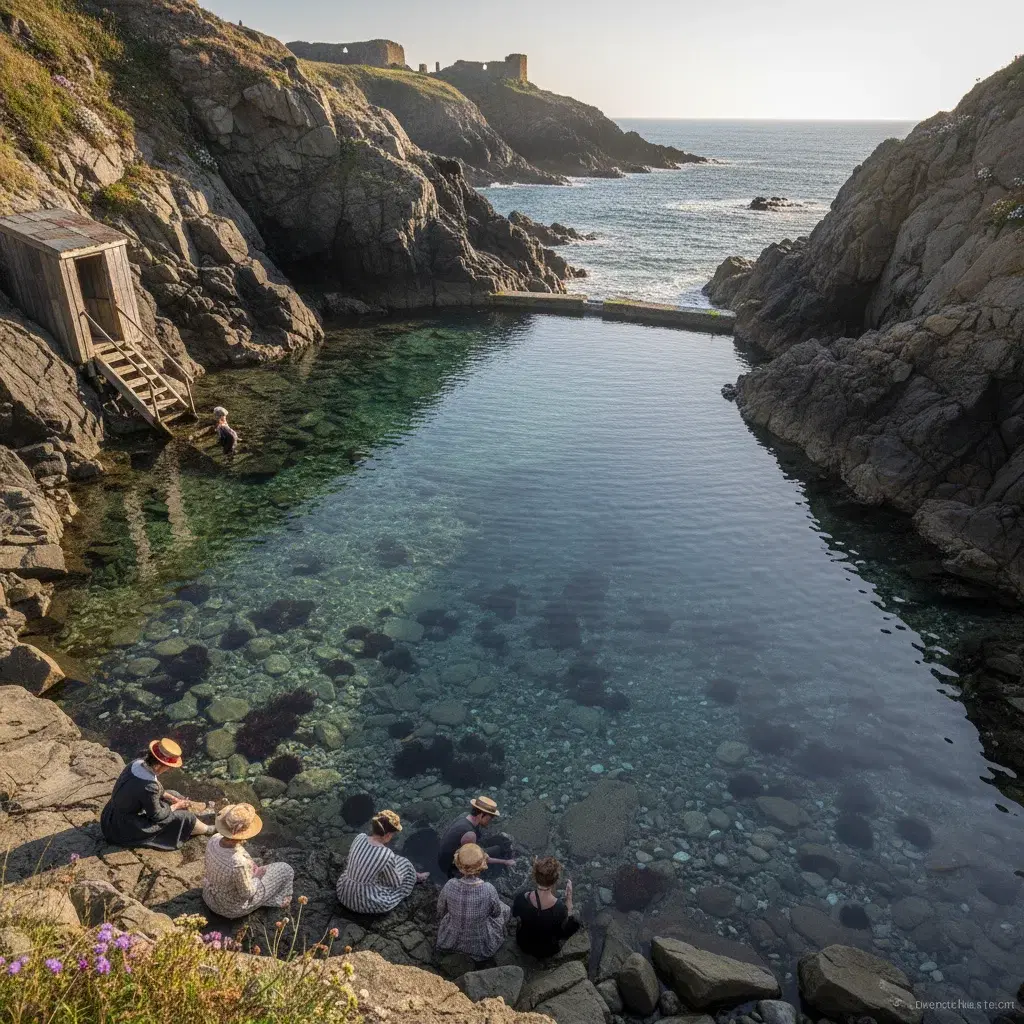
The Lost Lidos and Swimming History of Whitley Bay
Table Rocks tidal pool, the Tynemouth Outdoor Pool, sea bathing on the North Sea coast, and the Panama Swimming Club -- the swimming history of Whitley Bay.
Long before Waves leisure centre and its wave machine, the coast around Whitley Bay was lined with outdoor swimming pools and natural bathing spots. From a Victorian tidal pool blasted into the rocks to a concrete lido that served generations of Tyneside families, the area's swimming history runs deep.
Sea Bathing on the North East Coast
Swimming in the open sea was a popular -- and sometimes dangerous -- pastime along the North Tyneside coast from the late nineteenth century onwards. The seaside resorts of Cullercoats and Whitley Bay attracted bathers in large numbers, but the cold temperatures and unpredictable currents of the North Sea led to regular fatalities among Victorian and Edwardian trippers who were unused to the conditions.
Bathing machines appeared on Whitley Bay beach in the 1890s, allowing bathers -- particularly women -- to enter the water with a degree of modesty. But the risks of open-sea bathing created a demand for something safer: enclosed pools where families could swim without the dangers of tides and currents.
Table Rocks: Whitley Bay's Natural Lido
The earliest formal swimming pool on the Whitley Bay coast was at Table Rocks, at the northern end of the bay near Brown's Point. The site had a natural tidal pool formed in the flat rock platforms, and in 1894 a local man named W. Scott applied to the council for permission to develop it into a proper bathing pool.
The solicitor Charles Henry Megson Robson later claimed to have been the driving force behind the scheme, contributing 200 pounds of his own money and raising a further 28 pounds by public subscription. Around 1909, the natural pool was extended to approximately 70 feet by blasting the rock, creating a substantially larger swimming area.
Best for: The remains of Table Rocks pool are still visible at low tide, including the metal rings that once held the rope railings. The site is accessible from the coastal path north of Whitley Bay beach.
In 1910, the Whitley and Monkseaton Bathing Club was formed and made regular use of the pool. Members wore official red and black swimming costumes adorned with a winkle motif. A changing hut was built in 1912, though it was lost to gales just four years later. Steps were cut down to the pool and rope railings were fastened to the sides with metal rings -- some of which can still be seen in the rocks today.
At its peak, Table Rocks had separate changing facilities for men and women, believed to have remained in use until the 1950s. The pool's decline came gradually. The opening of the larger Tynemouth Outdoor Pool in 1925 drew bathers away, and Table Rocks fell out of regular use by the early 1970s. The pool was never demolished -- it was simply abandoned, and its outline remains visible in the rocks at low tide.
Tynemouth Outdoor Pool
Just down the coast at Tynemouth, a more ambitious outdoor pool opened on 30 May 1925. The Tynemouth Outdoor Swimming Pool was a concrete, rectangular, saltwater tidal pool, built partly in response to the annual drownings among visitors to the coast. It gave swimmers a safe, enclosed environment while still using the natural seawater that filled the pool with each tide.
The pool was enormously popular with both locals and holidaymakers for more than fifty years. During the summer months, it was packed with families, and it became one of the defining features of a day trip to the North Tyneside coast.
Like so many British lidos, the Tynemouth pool began to lose favour in the late 1970s as cheap package holidays to warmer destinations drew people away from the North Sea coast. The pool fell into disrepair. In the mid-1990s, the local authority demolished the ancillary buildings and bulldozed the rubble into the pool, filling it with concrete and imported boulders to create an artificial rock pool.
Best for: There is an active community campaign to restore Tynemouth Outdoor Pool. The Tynemouth Outdoor Pool organisation has been working towards the pool's revival -- visit tynemouthoutdoorpool.com for the latest updates.
The Panama Dips
The Panama Dips, on the Links between Whitley Bay and St Mary's Lighthouse, were never a formal swimming pool in the traditional sense, but they were an integral part of the town's bathing culture. The area took its name from a ship wrecked nearby in the 1930s.
The Dips were laid out as a public recreation area. A bandstand hosted Whitley Bay's orchestra, which played morning and evening sessions, and the area frequently featured entertainment including folk dancers from around the world. A glass-enclosed stage hosted string quartet performances on Sundays. A cafe, built from the wreck of a Cullercoats boat and designed to look like a beached ship, added to the nautical atmosphere.
Chalets lined the route towards St Mary's Lighthouse, and the combination of swimming, entertainment, and refreshments made the Panama Dips a popular destination in their own right. Today, the Panama Dip area is home to a skatepark (opened in 2008) and the Panama Swimming Club, but the bandstand, cafe, and chalets are long gone.
The Panama Swimming Club
One thread of continuity runs through more than ninety years of Whitley Bay's swimming history: the Panama Swimming Club. Founded in 1930, the club has offered North Sea swimming from the Links at Whitley Bay ever since. The current clubhouse dates from the early 1950s, with a brick ground floor and timber upper floor.
The club continues to swim in the open sea year-round, and in recent years the growing popularity of wild swimming has brought a new generation of members to the water. It is one of the oldest sea swimming clubs in the North East.
A Coast Built for Swimming
The outdoor pools and bathing spots that once lined the North Tyneside coast are mostly gone -- abandoned, bulldozed, or reclaimed by the sea. Table Rocks is a ruin visible only at low tide. Tynemouth's pool lies buried under concrete. The Panama Dips bandstand and cafe exist only in photographs and memories.
But the impulse that created them -- the desire to swim in the sea, safely and sociably -- has not gone away. The Panama Swimming Club still enters the North Sea from the same stretch of coast. Wild swimmers gather at Cullercoats Bay and along the rocks below St Mary's Lighthouse. And the campaign to restore Tynemouth Outdoor Pool suggests that the story of outdoor swimming on this coast may not be over yet.
Never miss what’s on
Join the weekly Whitley Bay.live digest — the best events, news and local tips, straight to your inbox. Free, one email a week.