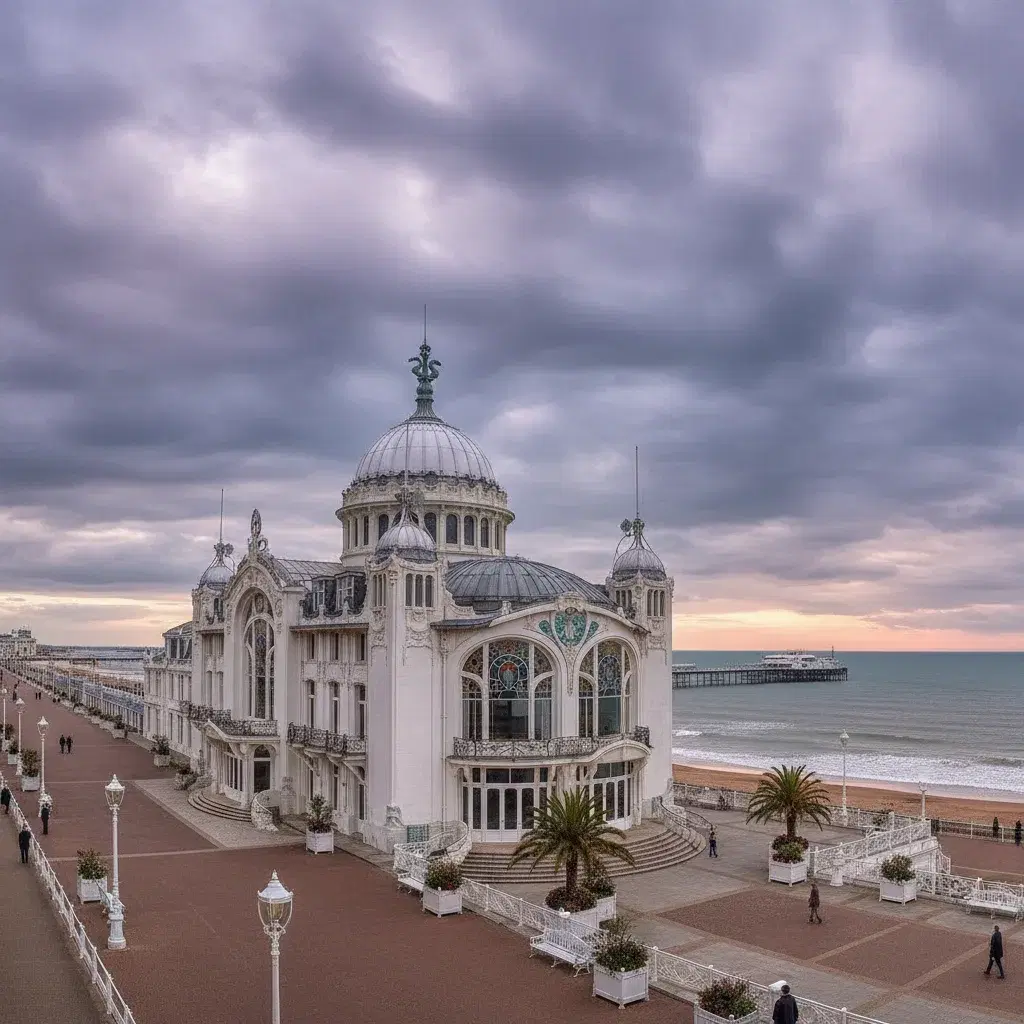
Spanish City: From Pleasure Palace to Modern Revival
The Toreadors concert party, the Empress Ballroom, the funfair, Dire Straits, and the 2018 restoration -- the full story of Whitley Bay's most iconic building.
The Spanish City dome is the defining landmark of Whitley Bay. Visible from miles along the coast, it has been a concert hall, a ballroom, a funfair, a ruin, and -- since 2018 -- a restaurant and events venue. Its history mirrors the fortunes of the town itself.
The Toreadors
The story begins in 1907 with Charles Elderton, a showman from Hebburn Theatre Royal. Elderton brought his Toreadors concert party to Whitley Bay's seafront, performing under large canvas and timber awnings that were painted to look like an old Spanish town. The audience loved it. The name stuck.
Following the success of that first season, Elderton established a more permanent presence. A venue opened on 6 March 1908, and in 1909 the Whitley Pleasure Gardens Company Ltd was formed to develop the site further. The company hired Newcastle architects Cackett and Burns Dick to design something more ambitious.
Opening Night: 14 May 1910
The result was the Spanish City and Whitley Bay Pleasure Gardens, which opened on the evening of Saturday 14 May 1910. Robert Mason, chair of the local council, performed the opening ceremony. Building had begun just sixty days earlier, in February 1910, completed at remarkable speed by builders Davidson and Miller.
The centrepiece was the ferro-concrete dome in free Baroque style, with a 180-foot Renaissance-style frontage facing the sea. The dome itself rose 75 feet from ground level -- the second largest in the country at the time, after St Paul's Cathedral in London. Beneath it sat a concert hall, restaurant, roof garden, and tearoom.
Best for: The Spanish City dome was completed in just sixty days in 1910. At 75 feet high, it was the second largest dome in the country after St Paul's Cathedral.
The Empress Ballroom
In 1920, the flat-floored theatre inside the dome was converted into the Empress Ballroom. It quickly became one of the most fashionable dance venues in the North East. The BBC broadcast regularly from the hall, and musicians of genuine stature performed there -- among them Billy Ternent, who went on to become a famous arranger, working with Frank Sinatra.
The Empress Ballroom continued in this role until 1961, hosting dances, concerts, and broadcasts across four decades that saw Whitley Bay at its peak as a seaside resort.
The Funfair Era
A permanent funfair grew up around the dome, eventually becoming one of the main attractions for visitors to the North East coast. Through the 1950s and 1960s, the Spanish City was synonymous with summer holidays -- waltzers, roller coasters, dodgems, and candy floss against the backdrop of the North Sea.
For generations of Tyneside children, a trip to the Spanish City was the highlight of the summer. The combination of fairground rides, the beach, and the nearby Panama Dips made Whitley Bay a complete day out.
"Tunnel of Love"
In 1980, Dire Straits released "Tunnel of Love", a song that would cement Spanish City's place in popular culture. Written by Mark Knopfler, who grew up in Newcastle about ten miles from Whitley Bay, the song is a vivid, semi-autobiographical account of visiting the fairground as a boy.
Knopfler later said that the Spanish City was the first place he heard rock and roll played really loud. The song references the fairground rides and the atmosphere of the place with an affection that resonated with anyone who had spent a summer afternoon there. From 1980 onwards, "Tunnel of Love" was played every morning when the funfair opened its gates.
Best for: Mark Knopfler of Dire Straits said the Spanish City was the first place he heard rock and roll played really loud. His 1980 song "Tunnel of Love" immortalised the fairground in popular culture.
Decline and Closure
The decline began in the 1970s and accelerated through the 1980s, as cheap package holidays to warmer destinations drew British families away from their traditional seaside resorts. Attendance at the Spanish City dropped steadily.
A succession of operators tried and failed to reverse the slide. The Coopers, the Granada Group, Whitley Gate Leisure, Northern Leisure, and Dobson Family Leisure all took ownership at various points, each promising major investment that never quite materialised. The addition of a Corkscrew roller coaster under Cooper's ownership was not enough to stem the decline.
By the 1990s, structural decay had become a serious concern. The funfair operated its final seasons in 1998 and 1999 before closing due to mounting disrepair. The entire complex shut its doors for good in 2000. Demolition of the fairground structures began in December 1999 and was completed by summer 2002, with the cleared site later becoming the location for Marine Park First School.
The dome itself survived, but stood empty and fenced off -- a Grade II listed building slowly deteriorating behind security barriers.
Restoration
The path back was long. In February 2007, North Tyneside Council announced plans to regenerate the Spanish City and the wider Whitley Bay seafront. In June 2011, architecture firm ADP won a commission for the restoration, with an initial completion date of 2014.
Work was halted in 2013 due to a lack of funds, but a Heritage Lottery Fund grant of 3.7 million pounds, announced in November 2013, helped get the project back on track. The restoration was painstaking, bringing the dome's historical features back to their Edwardian glory while fitting out the interior for a new generation of visitors.
The Spanish City reopened at the end of July 2018. Almost eighteen years after its final closure, the dome was once again open to the public.
What Is There Now
Today, the restored Spanish City houses several venues beneath its dome and along its seafront frontage. The fine-dining restaurant 1910 occupies a prime position, specialising in seafood and steak with views along the coast. Trenchers, an offshoot of the famous Whitby fish and chip restaurant, sits directly under the dome itself, with a pianist playing on selected evenings. Valerie's Tearoom offers a more relaxed setting, and a champagne bar and event spaces complete the offering.
The building also operates as a wedding and events venue, with the dome providing one of the most striking ceremony backdrops in the North East. The Spanish City Plaza outside hosts outdoor events and markets throughout the year.
Best for: Spanish City is open daily. The dome houses 1910 restaurant, Trenchers fish and chips, Valerie's Tearoom, and a champagne bar. It is also a popular wedding venue. Visit spanishcity.co.uk for current opening times.
A Building That Tells a Story
The Spanish City has been many things over more than a century -- pleasure palace, ballroom, funfair, ruin, and now a modern dining destination. Its story is inseparable from the story of Whitley Bay itself, and of British seaside culture more broadly. That the dome still stands at all, gleaming white against the North Sea, is a testament to the people who fought to save it.
Never miss what’s on
Join the weekly Whitley Bay.live digest — the best events, news and local tips, straight to your inbox. Free, one email a week.