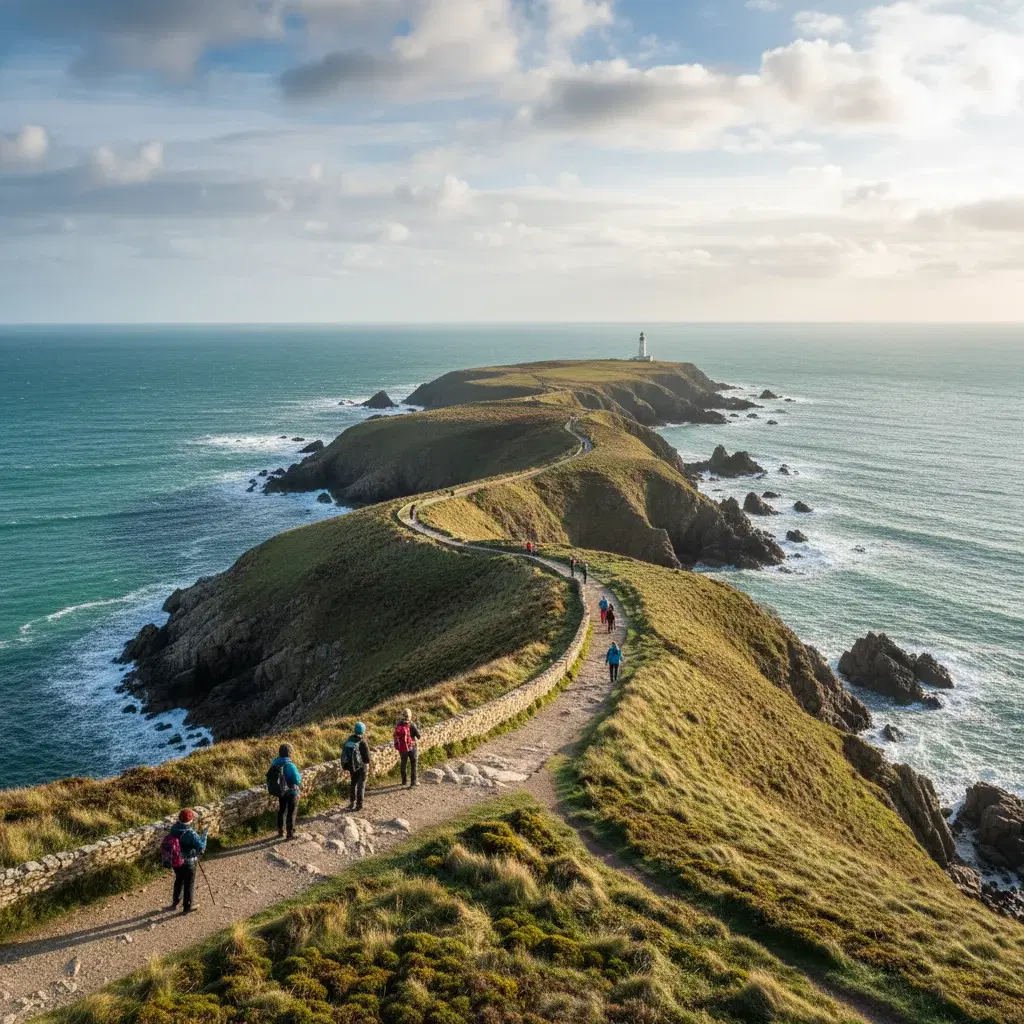
Heritage Walking Trail: Whitley Bay
A 3-mile walking trail through the story of Whitley Bay -- from the Spanish City dome and Edwardian seafront to the Panama Dip, Watts Slope, St Mary's Lighthouse, and the places where a fishing village became Tyneside's playground.
This self-guided heritage walk covers roughly 3 miles and takes around 1.5 to 2 hours at a comfortable pace, with time to stop and read interpretation boards along the way. The route traces the story of Whitley Bay from a quiet fishing village through its golden age as a seaside resort, decades of decline, and the remarkable regeneration that brought the Spanish City dome back to life.
The trail follows paved promenades, pavements, and coastal paths. Most of the route is accessible for pushchairs and wheelchairs, though the section to St Mary's Lighthouse involves a tidal causeway that is only passable at low tide.
Best for: Allow around 1.5 to 2 hours for the full trail. The route is approximately 3 miles and mostly flat on paved surfaces. Check tide times if you plan to walk to St Mary's Lighthouse.
Stop 1: Spanish City (Start)
Distance to next stop: 0.2 miles | 3 minutes
Begin at the Spanish City, the defining landmark of Whitley Bay. The white dome rising above the seafront has been a concert hall, a ballroom, a funfair, a ruin, and -- since its 2018 restoration -- a restaurant and events venue.
The story begins in 1907 when showman Charles Elderton brought his Toreadors concert party to the seafront. The permanent Spanish City and Whitley Bay Pleasure Gardens opened on 14 May 1910, with a ferro-concrete dome in free Baroque style rising 75 feet from ground level. The Empress Ballroom hosted dances and concerts for decades, and Dire Straits immortalised the building in their song Tunnel of Love.
The funfair closed in 2000, and the building stood derelict for years before a major restoration returned it to public use. Today it houses restaurants including 1910 Steak and Seafood and Valerie's Tearoom.
Read the full story in our Spanish City history guide.
Stop 2: The Promenade and Seafront
Distance to next stop: 0.3 miles | 5 minutes
Walk south from Spanish City along the promenade. This stretch of seafront is the heart of the Edwardian resort that Whitley Bay became after the railway arrived in 1862. Within a generation, a village of 300 people had transformed into a booming seaside town.
The promenade was where Edwardian visitors paraded in their best clothes, and the hotels and boarding houses that lined the streets behind it were filled every summer with families from Newcastle and the pit villages. At its peak, Whitley Bay was Tyneside's playground.
Look for the shelters along the promenade -- several date from the Edwardian and inter-war periods, built to give visitors somewhere to sit when the North Sea wind picked up.
Stop 3: The Links
Distance to next stop: 0.3 miles | 5 minutes
Continue south past the beach towards The Links, the open green space that runs between the seafront and the residential streets. The Links have been public open space since the Victorian development of the town, and they include play areas, the Links water park for children in summer, and wide grassy areas used for events.
During the resort's heyday, The Links hosted outdoor entertainment, donkey rides, and deckchair rentals. Today the space still serves the same purpose -- a place where families come to enjoy the coast.
Stop 4: Panama Dip
Distance to next stop: 0.4 miles | 7 minutes
Head south along the coast to the Panama Dip, one of Whitley Bay's most distinctive spots. The Panama was a natural dip in the coastline that became a popular gathering place for swimmers and sunbathers. It lent its name to the Panama Gardens and the Panama Swimming Club, which still swims in the North Sea here year-round.
The swimming history of Whitley Bay runs deep. Before modern leisure centres existed, outdoor pools and natural bathing spots were where everyone swam. Table Rocks, at the northern end of the bay, was a tidal pool blasted into the rock in the 1890s. The Panama area became its southern counterpart -- a place where hardy locals swam regardless of the season.
Best for: The Panama Swimming Club still swims in the North Sea at Panama Dip year-round, continuing a tradition that dates back over a century.
Stop 5: Watts Slope
Distance to next stop: 0.3 miles | 5 minutes
Walk up Watts Slope, one of the paths connecting the seafront to the town above. This path takes its name from the Watts family, who owned land in the area during the Victorian development of Whitley Bay.
From the top of the slope, you get a panoramic view along the coast -- the curve of the bay, the dome of the Spanish City to the north, and the sweep of beach stretching south towards Cullercoats. This is the view that sold the resort to Victorian visitors and developers alike.
The streets around you -- South Parade, The Promenade, Marine Avenue -- were laid out during the building boom that followed the railway, when developers raced to build boarding houses and hotels to meet the demand from Tyneside daytrippers and holidaymakers.
Stop 6: Former Rex Hotel Site
Distance to next stop: 0.3 miles | 5 minutes
Head north along South Parade towards the site of the former Rex Hotel. Originally built in 1906 as the Waverley temperance hotel, it grew to 150 bedrooms and became one of the largest hotels on the North East coast. During its later years, it hosted folk performers including Billy Connolly and Lindisfarne.
The Rex closed in 2016 and is now being converted into a care home. Its story mirrors the rise and fall of Whitley Bay itself -- built during the Edwardian golden age, thriving through the mid-twentieth century, and declining as cheap package holidays to Spain and Greece drew visitors away from British seaside towns from the 1970s onwards.
Stop 7: Brierdene
Distance to next stop: 0.4 miles | 7 minutes
Walk north through the residential streets to Brierdene, a wooded valley that runs inland from the coast. Brierdene is one of Whitley Bay's hidden green spaces -- a natural dene with a burn running through it, mature trees, and a path that provides a welcome contrast to the exposed seafront.
The dene existed long before the resort. While developers were laying out the promenade and building hotels, Brierdene remained a quiet, wooded valley. Today it is a local nature reserve and a popular short walk for residents.
Stop 8: St Mary's Lighthouse
Distance to next stop: 0.5 miles | 10 minutes
Continue north along the coast path to St Mary's Island and its lighthouse. The island is accessible via a tidal causeway from the car park at Old Hartley -- check tide times before you set out.
St Mary's Lighthouse was built in 1898 and operated until 1984, when it was decommissioned and converted into a visitor centre. The island and its surrounding rock pools are a designated Local Nature Reserve, and the rockpooling here is some of the best on the North East coast.
The lighthouse predates Whitley Bay's resort era, and the island has been a landmark for mariners for centuries. A medieval chapel dedicated to St Helen stood here before the lighthouse was built.
Stop 9: Return via the Coast Path (End)
Distance: 0.5 miles | 8 minutes back to Spanish City area
Walk back south along the coast path to return to the Spanish City area. The path runs along the clifftop with views across the North Sea, passing through the area where the history of Whitley Bay is written in the landscape -- from the fishing village that once sat quietly on the coast, to the booming resort, through the decline of the late twentieth century, and into the regeneration that continues today.
Practical Information
| Detail | Information |
|---|---|
| Distance | Approximately 3 miles (4.8 km) |
| Time | 1.5 to 2 hours |
| Terrain | Mostly flat, paved promenades and coastal paths |
| Start/End | Spanish City, Whitley Bay |
| Parking | Pay-and-display at Spanish City or The Links |
| Toilets | At Spanish City, The Links, and St Mary's Lighthouse car park |
| Refreshments | Spanish City restaurants, Park View cafes |
| Accessibility | Mostly accessible; St Mary's causeway is tidal and uneven |
Further Reading
- History of Whitley Bay -- from fishing village to seaside resort
- Spanish City: From Pleasure Palace to Modern Revival -- the full story of the dome
- The Rise and Fall of the Seaside Resort -- boom, bust, and comeback
- The Lost Lidos and Swimming History of Whitley Bay -- outdoor pools and sea bathing
Local businesses mentioned
Never miss what’s on
Join the weekly Whitley Bay.live digest — the best events, news and local tips, straight to your inbox. Free, one email a week.
What's On
Whitley Warriors v Paisley Pirates
7:00 PM · Whitley Bay Ice Rink, Hillheads Road, Whitley Bay, NE25 8HP
Whitley Bay parkrun
9:00am · The Links, Whitley Bay, NE26 1TQ
Whitley Warriors v Kirkcaldy Kestrels
5:00 PM · Whitley Bay Ice Rink, Hillheads Road, Whitley Bay, NE25 8HP