History of Whitley Bay
From a coastal village of 300 people to a Victorian seaside resort, through Spanish City's golden age to twenty-first century regeneration -- the history of Whitley Bay.
Whitley Bay is one of the most recognisable seaside towns on the North East coast. But its story stretches back long before the Spanish City dome or the promenade -- from a quiet fishing hamlet to a booming Victorian resort, through decades of decline, and into a remarkable modern revival.
A Coastal Village
In 1861, the settlement known simply as Whitley was a coastal village of around 300 inhabitants. It sat on the Northumberland coast between Cullercoats and Monkseaton, a modest collection of farms and fishermen's cottages with little to distinguish it from dozens of similar hamlets along the North Sea shore.
The area had a brief history of coal mining -- small-scale colliery work took place in the seventeenth and eighteenth centuries -- but by the Victorian era, the village's future lay not underground but along its wide, sandy beach.
The Railway Changes Everything
The transformation of Whitley Bay began with the railway. The North Eastern Railway opened a station at Whitley in 1862, connecting the coast to Newcastle and the industrial towns inland. The impact was immediate and dramatic.
By 1882, the North Tyne Loop line had opened, providing an even more direct route from Newcastle to the coastal villages. Developers saw the potential and began laying out new roads -- Station Road, the Esplanade -- and building grand hotels, guesthouses, and boarding houses to accommodate the growing number of visitors.
The population tells the story: from 300 in 1861 to roughly 6,800 by 1901, and then more than doubling again to 14,407 by 1911. To avoid confusion with Whitby in North Yorkshire, the town was officially renamed Whitley Bay in 1902.
Best for: The railway station opened in 1862 and transformed Whitley from a village of 300 into a booming resort of over 14,000 people within fifty years.
The Golden Age
The Edwardian era was Whitley Bay's golden age. Promenades were built along the seafront. Bathing machines appeared on the beach in the 1890s. Hotels and boarding houses lined the streets behind the seafront, and day-trippers arrived by train in their thousands during the summer months.
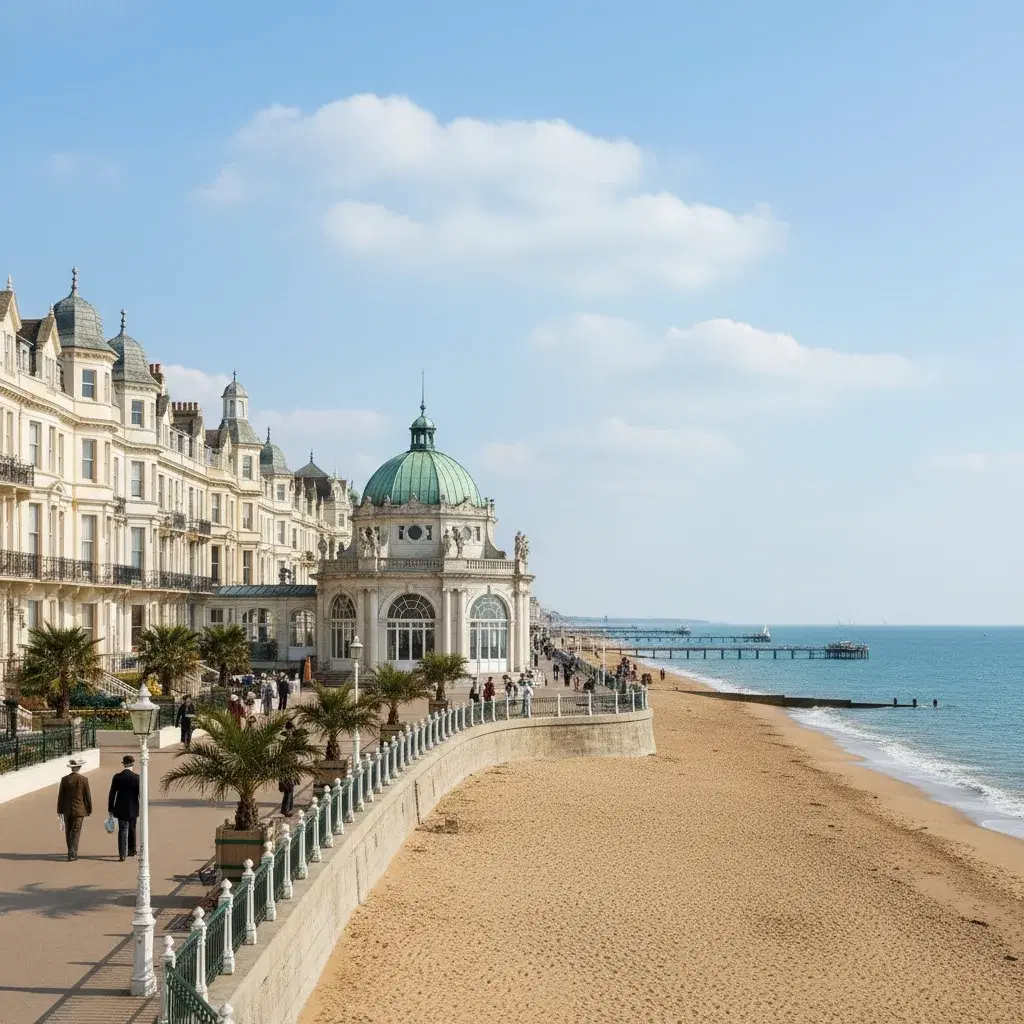
In 1907, the showman Charles Elderton brought his Toreadors concert party to the seafront, performing under canvas awnings painted to look like a Spanish village. The act was so popular that a permanent venue followed: the Spanish City and Whitley Bay Pleasure Gardens opened on 14 May 1910, complete with a concert hall, restaurant, roof garden, and tearoom, all beneath a ferro-concrete dome designed by architects Cackett and Burns Dick. At the time, it was the second largest dome in the country after St Paul's Cathedral.
The Panama Dips, further north along the Links, added to the town's appeal. A bandstand hosted orchestras and folk dancers, a cafe built from a Cullercoats boat wreck gave the area a nautical charm, and chalets lined the route towards St Mary's Lighthouse.
Between the Wars
The 1920s and 1930s saw Whitley Bay consolidate its position as the premier seaside resort for Tyneside. The Spanish City's theatre was converted into the Empress Ballroom in 1920, and it became one of the most fashionable dance halls in the region. The BBC broadcast regularly from the hall, and the future Frank Sinatra arranger Billy Ternent was a regular performer.
A permanent funfair grew up around the Spanish City, and by the mid-twentieth century the town's population had reached 36,517 (1961 census). Whitley Bay was a proper resort town, with everything from amusement arcades to ice cream parlours to deckchair hire on the beach.
Decline
The decline, when it came, followed a pattern familiar to British seaside towns. From the 1970s onwards, cheap package holidays to Spain and Greece drew families away from the North Sea coast. The Spanish City's funfair struggled through the 1980s and 1990s under a succession of owners, none of whom could halt the slide. It closed for good in 2000.
By the early 2010s, the town centre was in a difficult state. Some of the seafront hotels had become boarded up, the high street had empty shopfronts, and the Spanish City dome stood closed and deteriorating behind fencing.
Regeneration
The turnaround began in earnest in 2007 when North Tyneside Council announced plans to regenerate the seafront and town centre. A new skatepark opened in the Panama Dip in 2008. The Playhouse and Waves swimming pool were both refurbished and reopened in 2009. A new library and customer service centre followed in 2013.
The centrepiece was the restoration of the Spanish City itself. After receiving a Heritage Lottery Fund grant of 3.7 million pounds in 2013, the Grade II listed dome was painstakingly restored and reopened in July 2018 as a dining and leisure destination, housing the fine-dining restaurant 1910, Trenchers fish and chips, and Valerie's Tearoom.
Best for: The Spanish City dome reopened in July 2018 after an extensive restoration funded in part by the Heritage Lottery Fund. It now houses restaurants, a tearoom, and event spaces beneath its restored Edwardian dome.
Spanish City and Dire Straits
The Spanish City's place in popular culture was cemented in 1980 when Dire Straits released "Tunnel of Love". The song, written by Mark Knopfler, is a semi-autobiographical account of visiting the fairground as a boy. Knopfler grew up in Newcastle, about ten miles from Whitley Bay, and later said that the Spanish City was the first place he heard rock and roll played really loud. The song was played every morning when the funfair opened.
Whitley Bay Today
Modern Whitley Bay is a town that has found a new identity. Park View, the main street through the town centre, is lined with independent restaurants, cafes, and bars. The seafront has a Blue Flag beach, a restored promenade, and one of the best skateparks in the North East. Spanish City glows white against the sea, its dome once again the centrepiece of the coast.
The story of Whitley Bay -- from fishing village to Victorian resort, through golden age and decline, to its current revival -- is a story shared by many British seaside towns. But few have managed the comeback quite as well.
Never miss what’s on
Join the weekly Whitley Bay.live digest — the best events, news and local tips, straight to your inbox. Free, one email a week.