Victorian Whitley Bay: Architecture of a Seaside Resort
How the railway created a resort from nothing -- the Spanish City dome, the Rex Hotel, Edwardian promenades, cinemas, and the seafront terraces that gave Whitley Bay its character.
In 1860, Whitley Bay barely existed. A scattering of farmhouses, a few fishermen's cottages, and a population of around 300 people. By 1911, it was a booming seaside resort of over 14,000 residents, with hotels, promenades, cinemas, a pleasure dome, and streets of terraced boarding houses stretching back from the seafront. Almost every significant building in the town dates from this extraordinary half-century of construction -- and the architecture tells the story of how a railway turned a village into Tyneside's playground.
The Railway That Built a Town
The catalyst was the opening of the Blyth and Tyne Railway station in 1862. For the first time, families from Newcastle, North Shields, and the Northumberland pit villages could reach the coast in under an hour. They came in their thousands, and where the daytrippers went, developers followed.
Within a generation, speculative builders had laid out the grid of streets behind the seafront that still defines the town plan today. The streets running parallel to the coast -- South Parade, The Promenade, Marine Avenue -- were filled with boarding houses and small hotels. The streets running inland were residential, terraced houses for the people who worked in the new resort economy.
The result is a town that was essentially built in one go, between the 1870s and the First World War. This gives Whitley Bay an unusual architectural consistency -- the same materials (red brick, slate roofs, bay windows), the same proportions, and the same modest Victorian confidence run through street after street.
Best for: Whitley Bay's population grew from roughly 300 in 1860 to over 14,000 by 1911, driven entirely by the arrival of the railway and the demand for a seaside resort.
The Seafront Terraces
The seafront architecture is the most distinctive in the town. The terraces along South Parade and The Promenade were built to face the sea, with tall bay windows designed to catch the light and the view. Many were purpose-built as boarding houses or small hotels, with ground-floor dining rooms and bedrooms on the upper floors.
The style is typical of late Victorian seaside architecture across Britain -- decorative but not extravagant, built to a formula that could be repeated along the entire seafront. The materials are red brick with stone or rendered dressings, slate roofs, and the inevitable bay windows. What lifts these terraces above the ordinary is their setting: the curve of the bay, the sweep of the promenade below, and the North Sea beyond.
Several of the original seafront boarding houses survive, though many have been converted to flats or holiday lets. The proportions and the facades are largely intact, and on a sunny day the seafront terraces look much as they did when Edwardian visitors promenaded below them in their best clothes.
Spanish City: The Dome That Defines the Town
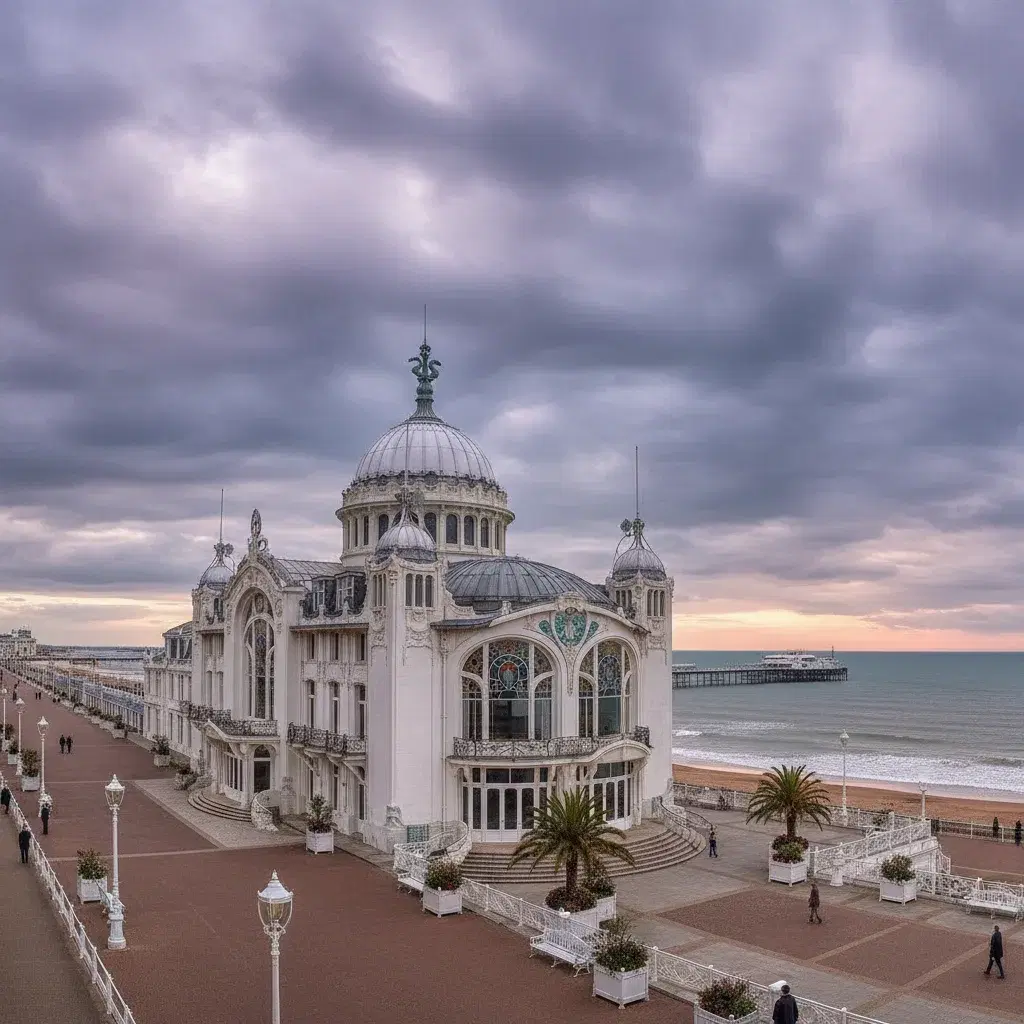
No building defines Whitley Bay more than the Spanish City. Its white dome, visible from miles along the coast, has been the town's landmark since 1910.
The story begins with Charles Elderton, a showman from Hebburn Theatre Royal, who brought his Toreadors concert party to the seafront in 1907. The act was a sensation. Within three years, Newcastle architects Cackett and Burns Dick had designed a permanent venue: the Spanish City and Whitley Bay Pleasure Gardens, which opened on 14 May 1910.
The centrepiece was a ferro-concrete dome in free Baroque style, with a 180-foot Renaissance frontage facing the sea. The dome itself rose 75 feet from ground level -- at the time, the second largest in the country after St Paul's Cathedral. The building is one of the earliest examples of Hennebique ferro-concrete construction involving a dome in the United Kingdom, making it architecturally significant well beyond its role as a seaside entertainment venue.
Beneath the dome sat a concert hall, restaurant, roof garden, and tearoom. In 1920 the flat-floored theatre was converted into the Empress Ballroom, which became one of the most fashionable dance venues in the North East. The BBC broadcast regularly from the hall.
After decades of decline -- the funfair closed in 2000 and the building stood derelict for years -- the dome was restored and reopened in 2018. Today it houses restaurants including 1910 Steak and Seafood and Valerie's Tearoom.
Read the full story in our Spanish City history guide.
Best for: The Spanish City dome is one of the earliest examples of Hennebique ferro-concrete dome construction in Britain. When completed in 1910, it was the second largest dome in the country after St Paul's Cathedral.
The Rex Hotel
At the southern end of the seafront stood the building that perhaps best captures the arc of Whitley Bay's fortunes. The Rex Hotel was originally built in 1906 as the Waverley, a small temperance hotel. It was a success, and expanded along the promenade to grow into a 150-bedroom hotel -- one of the largest on the North East coast.
In 1937 the hotel obtained a licence to sell alcohol and was renamed the Rex. Through the mid-twentieth century it was a popular venue for live music, hosting performers including Billy Connolly and Lindisfarne. At its peak, the Rex was Whitley Bay's grandest hotel, its imposing Victorian facade dominating the southern promenade.
The Rex closed in 2016 and is now being converted into a care home. Its story -- Edwardian ambition, mid-century popularity, late-century decline -- mirrors the rise and fall of Whitley Bay itself.
The Promenade and Edwardian Shelters
The Central Lower Promenade opened on 6 June 1914, designed by A.J. Ronsell. It originally stretched nearly 3,000 metres and contained a central shelter large enough to accommodate 600 people, with a terrace on its roof.
Along the promenade, three distinctive concrete shelters appear on the 1919 Ordnance Survey map. They are simple three-sided structures, open to the sea, with timber roofs supported on decorative cast-iron brackets. Several survive today and are among the most characterful features of the seafront -- functional Edwardian design that has aged with more grace than many grander buildings.
The promenade was where Edwardian visitors paraded in their best clothes, and the shelters gave them somewhere to sit when the North Sea wind picked up. The combination of promenade, shelters, and the green expanse of The Links behind them created the framework for a seaside resort that worked as well for a gentle stroll as for a day on the beach.
The Links and the Bandstand
The Links are the broad green space running between the seafront and the residential streets behind. They have been public open space since the Victorian development of the town, and their preservation is one of the reasons Whitley Bay's seafront feels so generous compared to resorts where developers built right up to the beach.
In 1933, plans were accepted for laying out the area around Panama Dip between the Panama House and Blyth Road, with a bandstand as part of the design. Whitley Bay's orchestra played morning and evening during the summer season -- a detail that captures the ambition of a resort town that saw itself as a rival to Scarborough or Southport.
The bandstand is gone, but The Links remain, still serving the same purpose they always have: a place where families come to enjoy the coast, with the seafront terraces behind them and the beach ahead.
Cinemas and Entertainment Architecture
At its peak, Whitley Bay supported at least four cinemas -- a remarkable number for a town of its size, and a reflection of the entertainment-driven economy that the resort had built.
- The Empire (later the Gaumont) opened on 30 June 1910, designed by architect Henry Gibson. It was taken over by the Gaumont British Theatres chain in 1928 and renamed the Gaumont in 1950.
- The Coliseum opened in 1910 for live theatre and variety. In 1919 it was extensively altered and reopened as the New Coliseum cinema for silent films.
- The Playhouse (originally the Kursaal) opened on 24 March 1913, designed by architects Charles T. Marshall and Pascal Joseph Stienlet. The German name became unpopular during the First World War and was changed. A serious fire in the late 1920s led to a rebuild by Marshall and Tweedy, reopening on 18 May 1931. The Playhouse survives today as a live music and theatre venue on Marine Avenue.
- The Picture House was part of the Spanish City complex.
These buildings represented a new kind of architecture -- entertainment palaces designed to give working-class visitors the sense of occasion and luxury they could not afford at home. Decorative facades, plush interiors, and prominent positions on main streets were all part of the formula.
Best for: Whitley Bay supported four cinemas at its peak -- the Empire, the Coliseum, the Playhouse, and the Picture House -- a remarkable concentration for a small seaside town.
What Survives Today
Whitley Bay's architectural story is one of survival against the odds. The decades of decline that followed the resort's golden age left many buildings derelict or demolished. But the bones of the Victorian and Edwardian town remain:
- Spanish City -- restored and reopened in 2018, the finest single building on the North East coast
- The Playhouse -- still operating as a live venue after more than a century
- The seafront terraces -- largely intact, their bay windows still facing the sea
- The promenade shelters -- Edwardian concrete and cast iron, quietly enduring
- The Links -- the green space that gives the seafront its generous character
- The street grid -- the Victorian layout of the town centre is essentially unchanged
The buildings that are gone -- the Rex Hotel, the Coliseum, the Empire -- left gaps that are slowly being filled by new development. But the character of the town remains unmistakably Edwardian: a place built for pleasure, designed to impress visitors arriving by train, and shaped by the confidence of an era that believed a seaside resort could be a thing of beauty.
For a walking route through these landmarks, see our Heritage Walking Trail. For the full story of the town's rise, fall, and regeneration, see Whitley Bay: The Rise and Fall of the Seaside Resort.
Have a suggestion? Get in touch.
Local businesses mentioned
Never miss what’s on
Join the weekly Whitley Bay.live digest — the best events, news and local tips, straight to your inbox. Free, one email a week.
What's On
Whitley Warriors v Paisley Pirates
7:00 PM · Whitley Bay Ice Rink, Hillheads Road, Whitley Bay, NE25 8HP
Whitley Bay parkrun
9:00am · The Links, Whitley Bay, NE26 1TQ
Whitley Warriors v Kirkcaldy Kestrels
5:00 PM · Whitley Bay Ice Rink, Hillheads Road, Whitley Bay, NE25 8HP